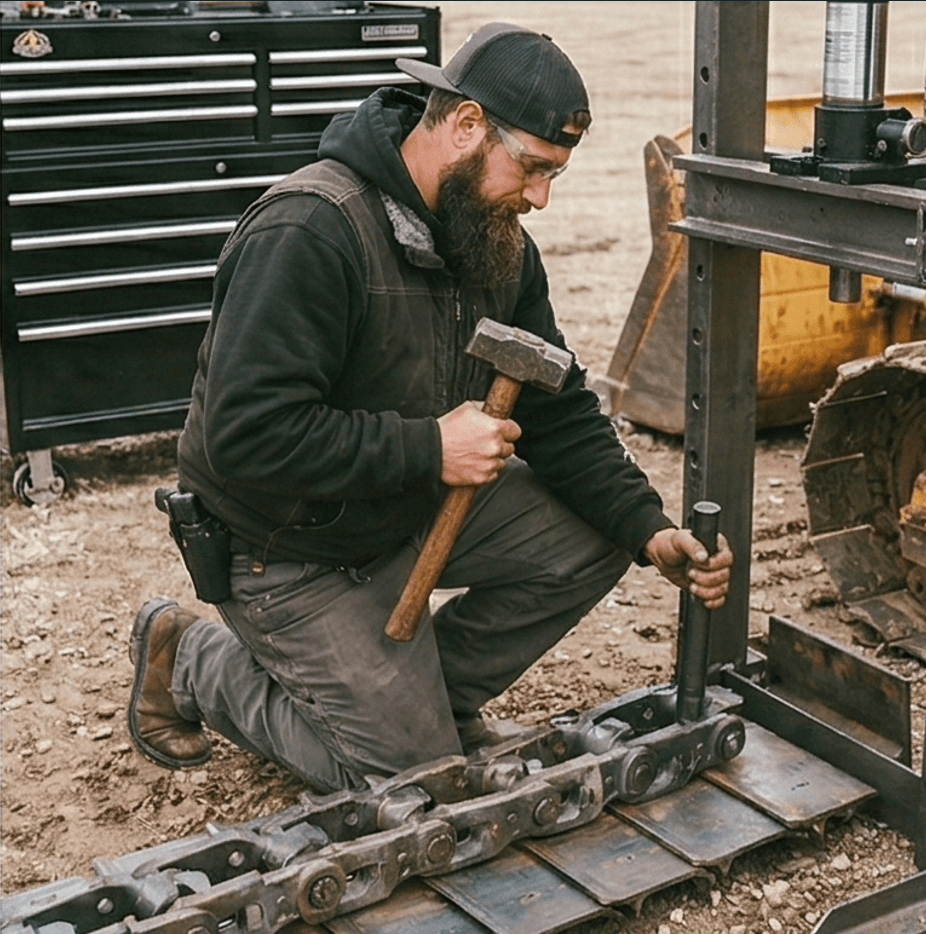
Boom and Bucket Drift: Why Your Iron Won’t Stay Put

You park your excavator at the end of the day with the boom up, and when you come back the next morning, the bucket is resting on the ground. That, my friend, is boom drift, and it’s one of the most annoying—and potentially dangerous—issues you’ll deal with! I’ve seen operators try to 'ignore' drift for months, but let me tell you, a boom that won't hold its position is a safety hazard waiting to happen. If you’re trying to set a pipe or hold a trench box and that boom starts to creep, someone’s going to get hurt. Drift is the machine’s way of telling you that high-pressure oil is escaping somewhere it shouldn't be.
In my 25 years of field service, I’ve learned that everyone immediately blames the cylinder seals. And sure, 70% of the time, it *is* the piston seals bypassing oil from the high-pressure side to the low-pressure side. But don't go tearing that cylinder apart just yet! I remember a job out in Ogden where a guy had rebuilt his bucket cylinder twice, and it was still drifting. He was fit to be tied! I showed up with my diagnostic kit and realized it wasn't the cylinder at all—it was a failing load-check valve in the main control bank. The oil was leaking back through the valve, not the piston. You have to be a detective when it comes to hydraulics; if you just swap parts, you’re just gambling with your boss’s money.
Practical tip from the trenches: Use the 'thermal test.' If a cylinder is drifting because of internal bypass, the oil moving through that tiny leak creates friction, and friction creates heat. Run the machine for twenty minutes, then use an infrared thermometer (or just the back of your hand, if you’re careful) to feel the cylinder barrel. If one spot is significantly hotter than the rest, you’ve found your bypass! If the barrel is cool but the valve bank is hot, your problem is likely in the controls. This little trick has saved me dozens of hours of unnecessary teardown time over the years.
At Iron Horse Field Service, we carry specialized 'blocking' tools on our trucks. We can isolate the cylinder from the rest of the system right there on your jobsite. If we block the lines and the boom still drifts, we know for a fact it’s the cylinder. If it stops drifting, the problem is 'upstream' in the valves. This kind of systematic troubleshooting is what separates a professional field tech from a 'parts changer.' Don't let a drifting boom kill your productivity—get it diagnosed right the first time and get back to digging!
Sluggish Swing and Travel: Chasing the Lost Flow

There’s nothing more frustrating than an excavator that digs like a champ but swings like a tired old turtle. If you have to 'wait' for your machine to turn, or if it feels like it has no power when you’re swinging uphill, you’ve got a swing system failure. This usually shows up when the oil gets hot. In the middle of a Utah summer, a worn swing motor will start to 'bypass' internally, losing its torque and speed. I’ve seen guys try to compensate by 'blipping' the travel pedals while they swing, but that’s just a great way to overheat your entire system!
Sluggishness in the swing or travel circuits is almost always a 'pressure vs. flow' battle. I once worked on a 30-ton machine in Tooele that had lost almost all its travel power on the left side. The owner was convinced the final drive was shot—a fifteen-thousand-dollar nightmare. I hooked up my flow meter and realized the main pump was putting out plenty of oil, but the 'swivel joint' (or center manifold) was leaking internally. The oil intended for the left track was crossing over into the return line. A three-hundred-dollar seal kit and a day of labor saved that machine from the scrap heap! You have to know how the oil flows through the 'heart' of the machine to find the truth.
Practical field advice: Watch your 'case drain' filters. Most swing and travel motors have a small line that returns 'leakage' oil back to the tank. If you see metal shavings in that case drain filter, your motor is disintegrating from the inside out. It’s like a biopsy for your hydraulics! If the oil is clean but the motor is weak, you might just have a misadjusted relief valve. We carry high-precision pressure gauges on our Iron Horse trucks, and we can 'dial in' your relief settings to factory specs in minutes. Sometimes, 'fixing' a machine is as simple as turning a screw half a turn to the right.
And don't ignore the pilot system! If your joysticks feel 'mushy' or if the machine responds slowly to your inputs, you might have low pilot pressure. The pilot system is the 'brain' that tells the main valves what to do. If the brain is tired, the muscles won't move. We check pilot pressure on every single service call because it’s the foundation of excavator performance. If your iron is feeling lazy, give us a shout. We’ll bring the diagnostics to you and find exactly where that flow is hiding. Let’s get that machine swinging and tracking like new again!
Contamination Control: The 8th-Grade Lesson Every Owner Needs
Listen, if you remember nothing else from my teaching, remember this: **Dirt is the devil!** 80% of all hydraulic failures are caused by contamination. That fine, powdery Utah dust might look harmless, but inside your pump, it acts like liquid sandpaper. It eats the brass, scores the pistons, and jams the tiny orifices in your control valves. I’ve seen a ten-thousand-dollar pump destroyed in a single week because an operator was 'careless' with a dirty funnel when topping off the oil. It’s a heartbreaking waste of money!
I tell my guys that 'clean' isn't just a suggestion; it’s a religion. When we open a system in the field, we use lint-free rags, we cap every single line, and we clean the area around the fittings *before* we turn a wrench. I’ve seen 'mechanics' pull a hose and let it drop into the mud while they go get a tool. That hose is now a delivery system for a handful of grit that’s headed straight for your main valve bank. If your mechanic doesn't treat your hydraulic oil like it’s liquid gold, you need a new mechanic!
Practical tip: Take oil samples! At Iron Horse Field Service, we’re huge fans of scheduled oil analysis. It’s like a blood test for your machine. For about forty bucks, a lab can tell you exactly what’s wearing out by the type of metal in the oil. If we see high levels of chrome, we know your cylinder rods are scoring. If we see brass, your pump is dying. This allows us to schedule a 'planned' repair before you have a 'catastrophic' failure that dumps metal through the entire system. Once metal gets into the tank, you’re looking at a bill that’s three times higher because you have to flush every line and cylinder.
The best way to 'fix' hydraulic issues is to prevent them. Operators who 'slam' the controls and bottom out cylinders under full pressure are the ones who keep mobile mechanics in business. Smooth operation reduces pressure spikes that blow seals and fatigue hoses. If your operators are noticing changes in machine behavior in Ogden or Provo, listen to them! They spend 10 hours a day in that seat; they know when the machine is 'lying' to them. Early reporting saves thousands. Keep it clean, keep it smooth, and let’s keep that iron moving! If you’re worried about contamination or just want a professional 'system health check,' give us a call. We’re here to help you dig deeper and last longer.
Need repair help fast?
Tell us your equipment details, jobsite location, and symptoms. We’ll follow up to confirm scheduling and dispatch service.